
Search results: 3992
Description. This course includes Economic evaluation methods for industrial projects; deterministic and stochastic methods; deterministic investment analysis, application of algebraic, linear, and non-linear programming models; comparison of multiple projects under singular or multiple constraints.
Prerequisites. None. (2nd year Standing)
Objectives. At the end of the course, the student should be able to: 1) apply economic evaluation and mathematical programming methods in making decisions in single and multiattribute decision environments and 2) conduct modeling and tradeoff analysis for multicriteria and/or multi-objective problems.
TOPICS (tentative)
1. Foundations of Engineering Economy
2. Interest and Time Value of Money
3. Economic Equivalence
4. Nominal and Effective Interest Rates
5. Depreciation
7. Basic Analysis Tools
8. Break-even and Payback analysis
9. Benefit/Cost Ratio
10. Selection Among Alternatives
11. Decisions Under Uncertainty
13. Multi-Attribute Decision-Making
Reference Text
Sullivan, W., Wicks, E., and Luxhoj, J. (2006). Understanding Engineering Economy (13th ed). Jurong, Singapore: Pearson Education South Asia Pte. Ltd.
Clemen, R. and Reilly, T. (2014). Making Hard Decisions with DecisionTools®, (3rd ed). Ohio, USA: Cengage Learning.
Blank, L. and Tarquin, A. (2012). Engineering Economy., (7th edition). Avenue of the Americas, New York: McGraw-Hill Companies.
Sta. Maria, H.B. (2007) Engineering Economy. 3Rd Edition. National Book Store
Sharma, K.R. (2011) Fundamentals of Engineering Economics. University Readers Inc., United States of America.
Tiong, J. (2014). General Engineering and Applied Science Third Edition. Imus, Cebu City. First Benchmark Publisher, Inc.
Course Requirement/s: (tentative)
Attendance (Async/Sync)
1. Examinations
2. Quizzes
3. Worksheets (Assignment, Problem sets)
NOTES
1. The references are not limited to the references listed in the syllabus.
2. Utilization of other instructional materials like the use of the internet, using reliable websites for surfing, etc. are also a part of the actual instruction.
3. A new trend in technology relevant to the subject matter not mentioned in this course syllabus is also a part of the actual instructions
- Teacher: Silverio Magday
- Enrolled students: 42
Engineering Economy is the process of making rational and intelligent decisions associated with the allocation of scarce resources in circumstances in which alternatives can be enumerated.
- Teacher: Jessica Castillo
- Enrolled students: 44
Description. This course includes Economic evaluation methods for industrial projects; deterministic and stochastic methods; deterministic investment analysis, application of algebraic, linear, and non-linear programming models; comparison of multiple projects under singular or multiple constraints.
Prerequisites. None. (2nd year Standing)
Objectives. At the end of the course, the student should be able to: 1) apply economic evaluation and mathematical programming methods in making decisions in single and multiattribute decision environments and 2) conduct modeling and tradeoff analysis for multicriteria and/or multi-objective problems.
TOPICS (tentative)
1. Foundations of Engineering Economy
2. Interest and Time Value of Money
3. Economic Equivalence
4. Nominal and Effective Interest Rates
5. Depreciation
7. Basic Analysis Tools
8. Break-even and Payback analysis
9. Benefit/Cost Ratio
10. Selection Among Alternatives
11. Decisions Under Uncertainty
12. Review of Probability
13. Multi-Attribute Decision-Making
Reference Text
Sullivan, W., Wicks, E., and Luxhoj, J. (2006). Understanding Engineering Economy (13th ed). Jurong, Singapore: Pearson Education South Asia Pte. Ltd.
Clemen, R. and Reilly, T. (2014). Making Hard Decisions with DecisionTools®, (3rd ed). Ohio, USA: Cengage Learning.
Blank, L. and Tarquin, A. (2012). Engineering Economy., (7th edition). Avenue of the Americas, New York: McGraw-Hill Companies.
Sta. Maria, H.B. (2007) Engineering Economy. 3Rd Edition. National Book Store
Sharma, K.R. (2011) Fundamentals of Engineering Economics. University Readers Inc., United States of America.
Tiong, J. (2014). General Engineering and Applied Science Third Edition. Imus, Cebu City. First Benchmark Publisher, Inc.
Course Requirement/s: (tentative)
Attendance (Async/Sync)
1. Examinations
2. Quizzes
3. Worksheets (Assignment, Problem sets)
NOTES
1. The references are not limited to the references listed in the syllabus.
2. Utilization of other instructional materials like the use of the internet, using reliable websites for surfing, etc. are also a part of the actual instruction.
3. A new trend in technology relevant to the subject matter not mentioned in this course syllabus is also a part of the actual instructions
- Teacher: Silverio Magday
- Teacher: Rojan Reyes
- Enrolled students: 46
Description. This course includes Economic evaluation methods for industrial projects; deterministic and stochastic methods; deterministic investment analysis, application of algebraic, linear, and non-linear programming models; comparison of multiple projects under singular or multiple constraints.
Prerequisites. None. (2nd year Standing)
Objectives. At the end of the course, the student should be able to: 1) apply economic evaluation and mathematical programming methods in making decisions in single and multiattribute decision environments and 2) conduct modeling and tradeoff analysis for multicriteria and/or multi-objective problems.
TOPICS (tentative)
1. Foundations of Engineering Economy
2. Interest and Time Value of Money
3. Economic Equivalence
4. Nominal and Effective Interest Rates
5. Depreciation
6. Capital Financing
7. Basic Analysis Tools
8. Break-even and Payback analysis
9. Benefit/Cost Ratio
10. Selection Among Alternatives
11. Decisions Under Uncertainty
12. Review of Probability
13. Multi-Attribute Decision-Making
Reference Text
Sullivan, W., Wicks, E., and Luxhoj, J. (2006). Understanding Engineering Economy (13th ed). Jurong, Singapore: Pearson Education South Asia Pte. Ltd.
Clemen, R. and Reilly, T. (2014). Making Hard Decisions with DecisionTools®, (3rd ed). Ohio, USA: Cengage Learning.
Blank, L. and Tarquin, A. (2012). Engineering Economy., (7th edition). Avenue of the Americas, New York: McGraw-Hill Companies.
Sta. Maria, H.B. (2007) Engineering Economy. 3Rd Edition. National Book Store
Sharma, K.R. (2011) Fundamentals of Engineering Economics. University Readers Inc., United States of America.
Tiong, J. (2014). General Engineering and Applied Science Third Edition. Imus, Cebu City. First Benchmark Publisher, Inc.
Course Requirement/s: (tentative)
Attendance (Async/Sync)
1. Examinations
2. Quizzes
3. Worksheets (Assignment, Problem sets)
NOTES
1. The references are not limited to the references listed in the syllabus.
2. Utilization of other instructional materials like the use of the internet, using reliable websites for surfing, etc. are also a part of the actual instruction.
3. A new trend in technology relevant to the subject matter not mentioned in this course syllabus is also a part of the actual instructions
- Teacher: Silverio Magday
- Teacher: JOEL MENDOZA
- Enrolled students: 34

- Teacher: Jessica Castillo
- Enrolled students: No students enrolled in this course yet
Engineering management is the application of the practice of management to the practice of engineering. Engineering management is a career that brings together the technological problem-solving ability of engineering and the organizational, administrative, and planning abilities of management in order to oversee the operational performance of complex engineering driven enterprises.
- Teacher: Engr. JUN T. ROSARIO
- Enrolled students: 9
- Teacher: Karen Grace Sugue
- Enrolled students: 9
- Teacher: Marvin Ryan Ferrer
- Enrolled students: 21
- Teacher: ANDY GUALON
- Teacher: AURUS JODEO TIAM
- Enrolled students: 10
- Teacher: AURUS JODEO TIAM
- Enrolled students: 25
- Teacher: Karen Grace Sugue
- Enrolled students: 7
- Teacher: ROD KLINE PERPETUA
- Enrolled students: 19
- Teacher: TERESITA REYES
- Enrolled students: 14
- Teacher: TERESITA REYES
- Enrolled students: No students enrolled in this course yet
- Teacher: Karen Grace Sugue
- Enrolled students: 21

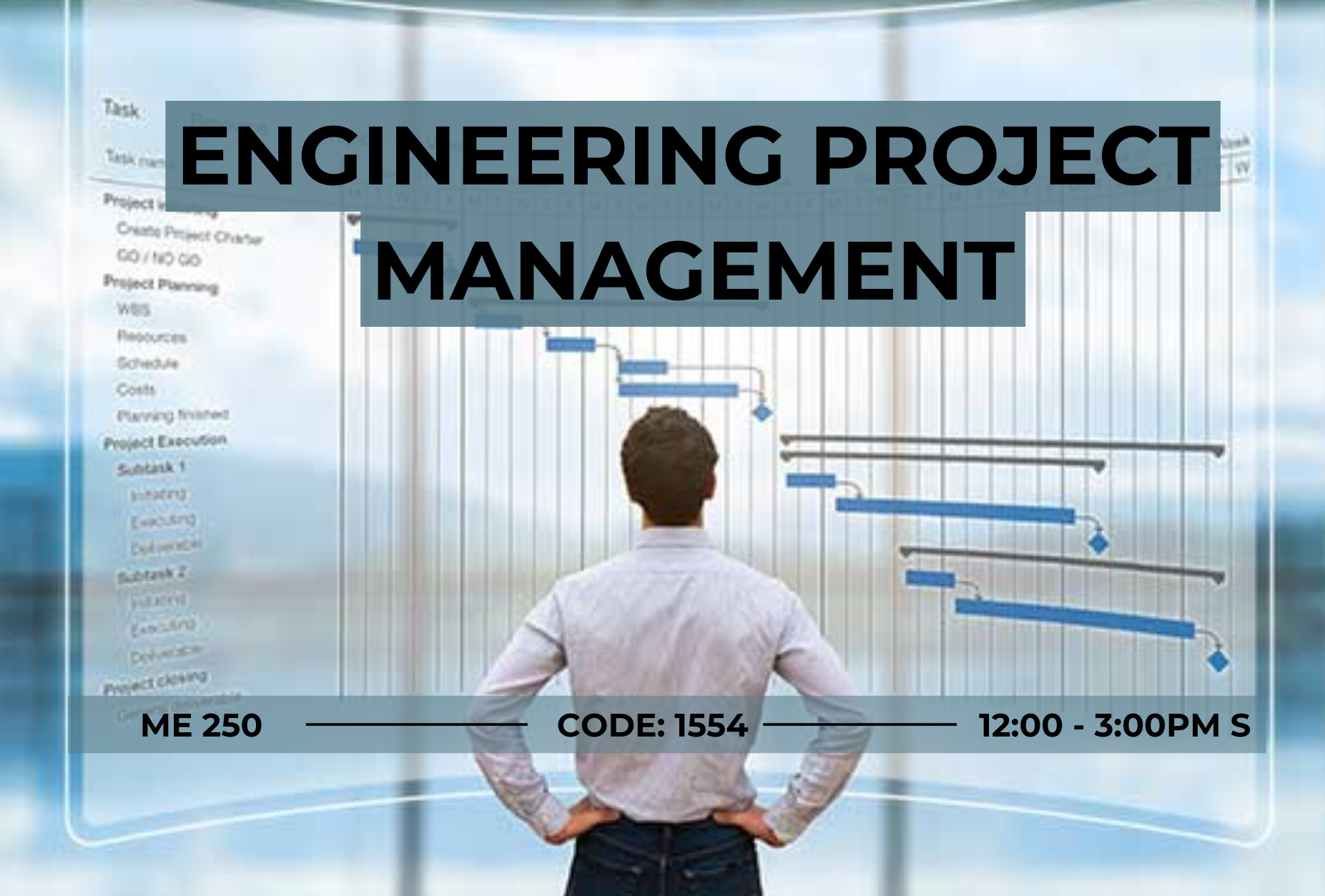
Engineering Project Management for Construction
Engineering project management in construction involves planning, executing, and overseeing construction projects to ensure they are completed on time, within budget, and according to quality and safety standards. It integrates engineering principles with project management techniques to manage resources, schedules, risks, and stakeholders effectively.
- Teacher: Engr. JUN T. ROSARIO
- Enrolled students: 20

8:00-11:00 AM
Saturday
- Teacher: JEFRIE ALINDAYU
- Enrolled students: No students enrolled in this course yet
- Teacher: Michelle Kyra BAUTISTA
- Enrolled students: 15
- Teacher: RINO FRANZ GUMAYAGAY
- Enrolled students: 40
- Teacher: RINO FRANZ GUMAYAGAY
- Enrolled students: 41