
Search results: 64
This course delves into the multifaceted landscape of contemporary language research, equipping graduate students with the critical thinking skills and methodological expertise, including the application of ethics in research, necessary to conduct impactful and innovative investigations. Moving beyond theoretical foundations, the course emphasizes the practical application of diverse research paradigms and analytical techniques to address pressing questions about the nature, use, and acquisition of human language in its myriad forms and contexts.
- Teacher: ZAYDA ASUNCION
- Enrolled students: 1
The course focuses on applying univariate and bivariate statistical theories, techniques, and procedures to find probable answers to educational research questions, including data analysis related to statistical investigations in education. The major concern of the course is statistical inference with applications in education and the use of computer software in processing data for analysis.
- Teacher: DOMINGA VALTORIBIO
- Enrolled students: 25
This general course is intended to develop the communicative competence, as well as the cultural awareness of all students through all the macro-skills of language use: Listening, Speaking, Reading, and Writing; in preparation for their communicative performance in their respective occupations.
- Enrolled students: No students enrolled in this course yet
- Teacher: Felipe Nantes
- Enrolled students: 20
- Teacher: Jun Valtoribio
- Enrolled students: 41

This doctorate course deals with the analysis of quantitative data facilitated by statistical software. It involves descriptive and inferential analysis of data (univariate, bivariate and multivariate) using spreadsheet application (e.g. MSExcel, OpenCalc), software for statistical analysis (e.g. SAS, SPSS, Open source PSPP) and modeling (SEM). Computer data analysis tasks to be undertaken include designing of coding schemes, data encoding, data sanitation and management, descriptive analysis, statistical inference, diagnostic, data transformation and interpretation of output.
- Teacher: MOISES ALEXANDER ASUNCION
- Teacher: MELANIE GURAT
- Enrolled students: 3
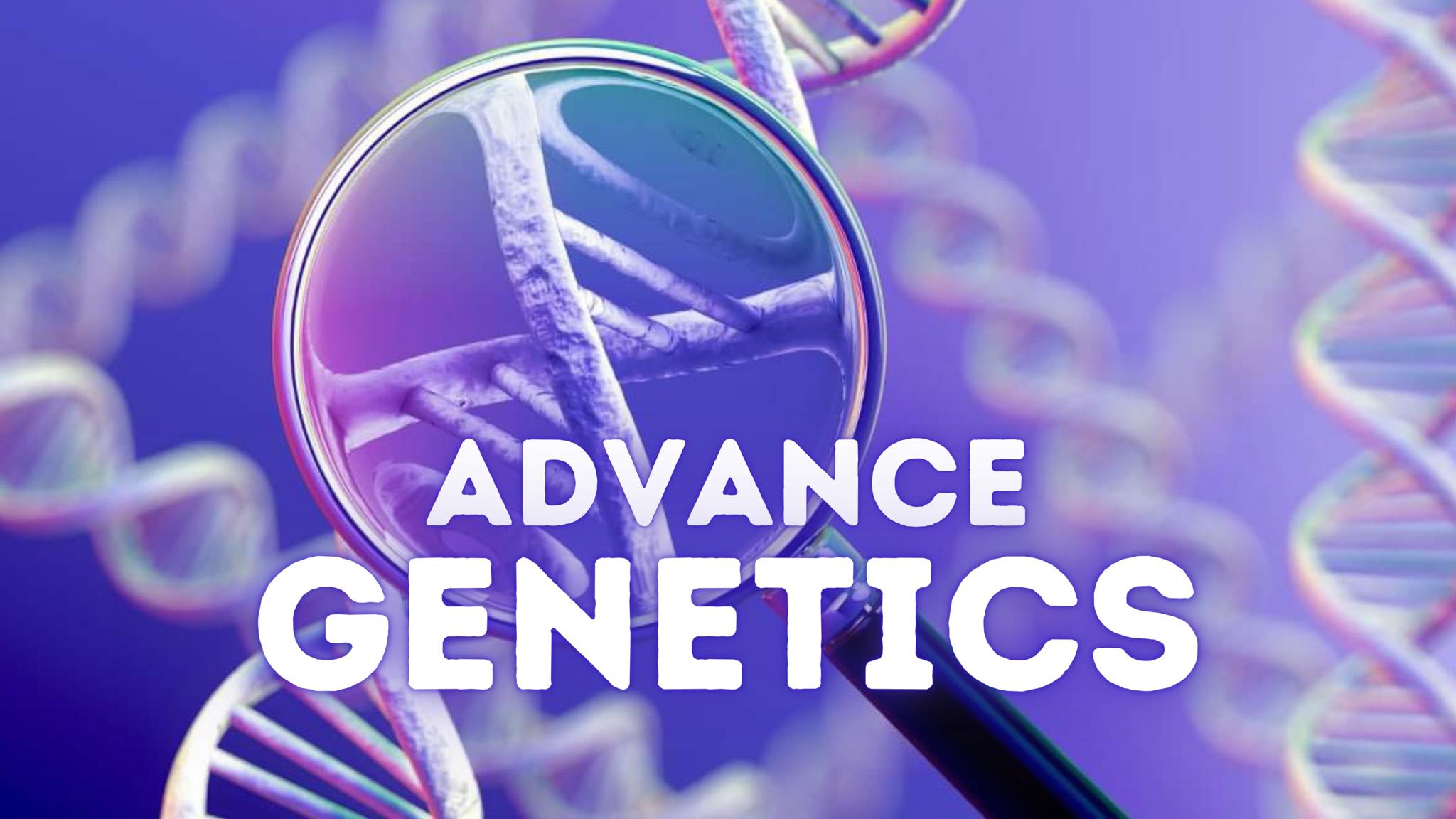
This course presents Genetics along the concepts and principles of molecular and cellular basis of inheritance, classical or transmission Genetics, population Genetics and DNA Biotechnology. Each of the topics requires comprehensive, mathematical, interpretative and predictive analyses.
- Teacher: CATHELYN MARIANO
- Enrolled students: 3
- Teacher: JASON ARNOLD MASLANG
- Enrolled students: 2
This course deals with advanced concepts in altered physiologic functions of the heart. It focuses on a deeper understanding of the heart and its implications to a more scientifically-based clinical assessment and nursing care of patients with cardiac ailments. Emphasis is placed on understanding how the heart functions, and how cardiac diseases affect the heart’s efficiency in maintaining homeostasis. It incorporates pharmacological concepts, diagnostic tests/procedures using pathophysiological approach to understanding the medical and surgical management of the altered physiology.
- Teacher: JOMAN BALITON
- Enrolled students: 1
- Enrolled students: No students enrolled in this course yet
. Course Description
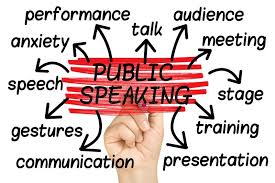
Advance Oral Communication is a general education course offered to students enrolled in the School of Accountancy and Business, School of Engineering and Information Technology, School of Health and Applied Sciences and School of Teacher Education and Humanities. This course is designed to develop students’ oral communication skills for effective personal, group, and public communication in various disciplines. It includes basic knowledge and concepts as the conceptual and theoretical foundations of oral communication. This course provides an opportunity for the students to manifest their knowledge and skills by undergoing actual activities in speaking.
- Teacher: Susana Cadano
- Enrolled students: 9
Advance Oral Communication is a general education course offered to students enrolled in the School of Accountancy and Business, School of Engineering and Information Technology, School of Health and Applied Sciences and School of Teacher Education and Humanities. This course is designed to develop students’ oral communication skills for effective personal, group, and public communication in various disciplines. It includes basic knowledge and concepts as the conceptual and theoretical foundations of oral communication. This course provides an opportunity for the students to manifest their knowledge and skills by undergoing actual activities in speaking.
- Teacher: John Vicente
- Enrolled students: 32
This is a course in linear algebra for MST Mathematics graduate students. It covers basic linear algebra tools such as matrices, matrix operations and properties and determinants, vector spaces, linear transformations, eigenvalues and eigenvectors, and diagonalization.
- Teacher: DONNA BEE TOMINEZ
- Enrolled students: 14
![Arch'l Visual Communications 3 - Graphics 2 [4017/4018]](https://lms.smu.edu.ph/pluginfile.php/193307/course/overviewfiles/Graphics%202%20Cover.jpg)
An introduction to measured drawings applying graphic conventions; the study of pictorial presentation and perspective projections; plotting of shades and shadows in both orthographic and perspective drawings.
- Teacher: CHRIS DOMINGUEZ
- Enrolled students: 39
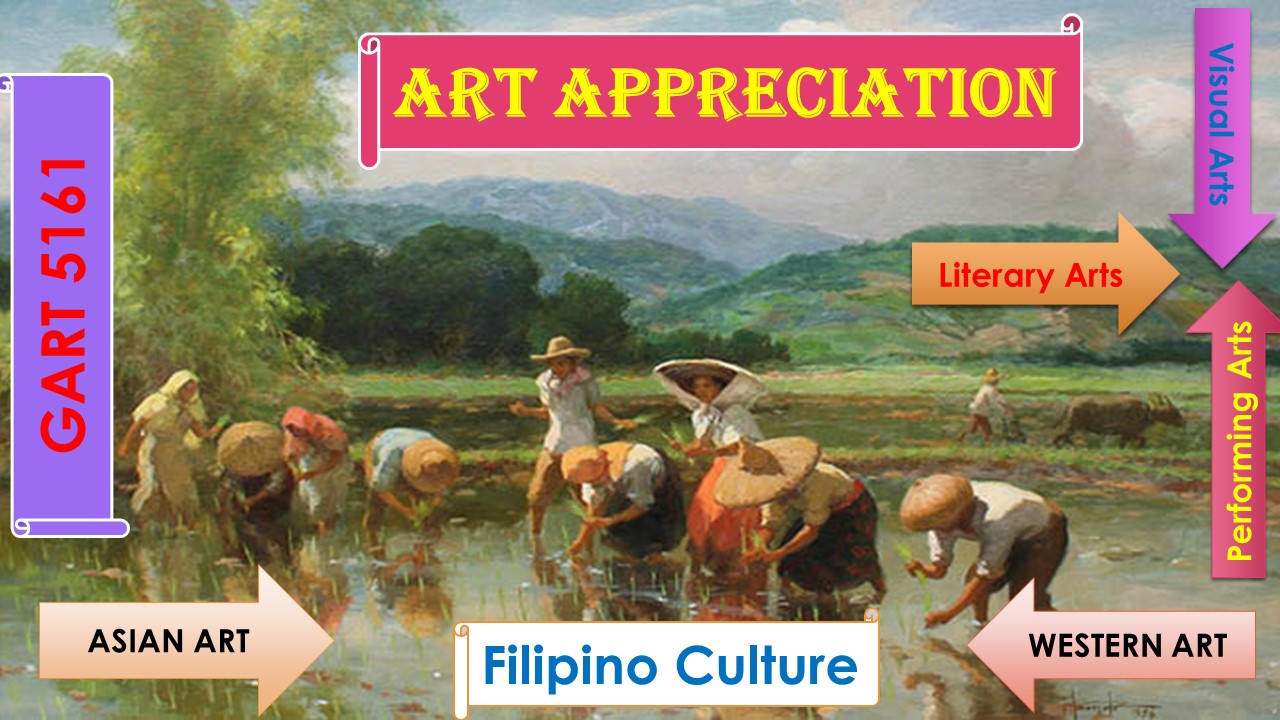
The main thrust of this course is to equip the students to develop the ability to appreciate, evaluate and appraise works of art. This is attained by interdisciplinary and multi-modal approaches where students will be equipped with broad knowledge of the practical, the historical, philosophical and social relevance of art. Purposely, this is to sharpen students’ ability to articulate their understanding of arts. The course also designs to develop students’ competency in researching and curating art as well to conceptualize, mount and evaluate art productions. The course aims to develop students’ genuine appreciation for Philippine arts by providing them opportunities to explore the diversity and richness and their rootedness in Filipino culture.
- Teacher: LUZ ILDEFONSO
- Enrolled students: 40
- Enrolled students: No students enrolled in this course yet
Social Studies teachers must be schooled not only in the subject matters of the Social Sciences but in the analysis of the interplay between theory and practice. This course is intended to provide Social Studies graduate students the ability to align relevant Social Studies core contents, practice in the arts of pedagogy attuned to the needs of diverse students, with appropriate assessment tools and techniques to objectively measure students’ learning. In a nutshell, the course offers quality assessments of students’ learning via information on the core principles of effective assessment, nature of assessment, its indicators and sample instruments and ultimately, a scrutiny of the alignment between and among curriculum, instruction, evaluation and assessment.
- Teacher: KENNETH MASLANG
- Enrolled students: 9
- Teacher: SAMUEL DAMAYON
- Enrolled students: No students enrolled in this course yet
- Enrolled students: No students enrolled in this course yet
- Teacher: Arlene Tabaquero
- Enrolled students: 15
- Teacher: Samuel Soliven
- Enrolled students: 1
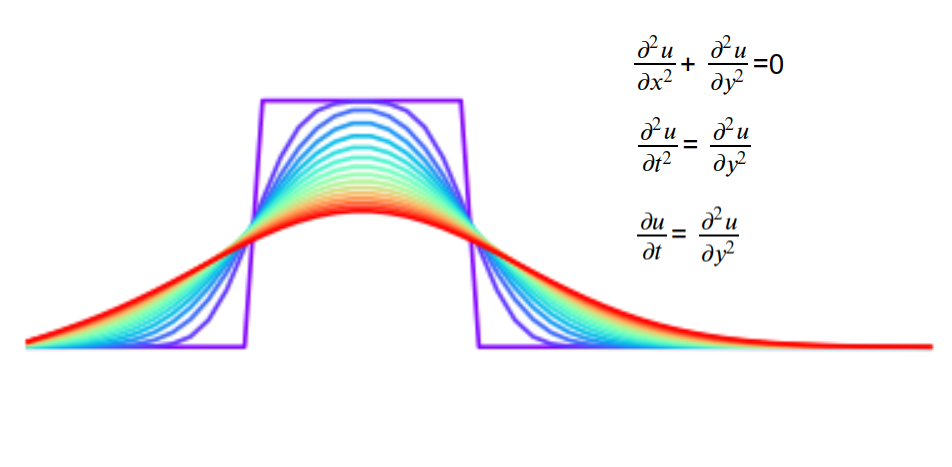
This is an introductory course in ordinary differential equations (ODEs). It focuses primarily on techniques for finding explicit solutions to linear ordinary differential equations. Topics include first order ordinary differential equations, linear differential equations, linear equations with constant coefficients, non-homogeneous equations, undetermined coefficients and variation of parameters, linear systems of equations; the existence and uniqueness of solutions.
- Teacher: ROWENA RIVERA
- Enrolled students: 16
- Teacher: Rojan Reyes
- Enrolled students: 39
- Teacher: JONATHAN VERGARA
- Enrolled students: 50
- Enrolled students: No students enrolled in this course yet
The course deals with the varied approaches designing experimental research with particular focus on applications in science education research. It opens with a brief discussion of research design strategies and perspectives to establish the importance of experimental research designs. The wide array of group and single/diagrammatic, procedural and analytical discussions. The group designs include pre-experimental, true experimental, quasi-experimental, time series, factorial, counter-balanced and action research designs; while the single-subjects designs include the baseline designs. Data analysis is performed with the two-sample procedures and analysis of variance and covariance. Threats to generalizability of results (internal and external validity) of experiments are identified and clarified with the hope of controlling them through the most appropriate experimental design.
- Teacher: MELANIE GURAT
- Enrolled students: 2
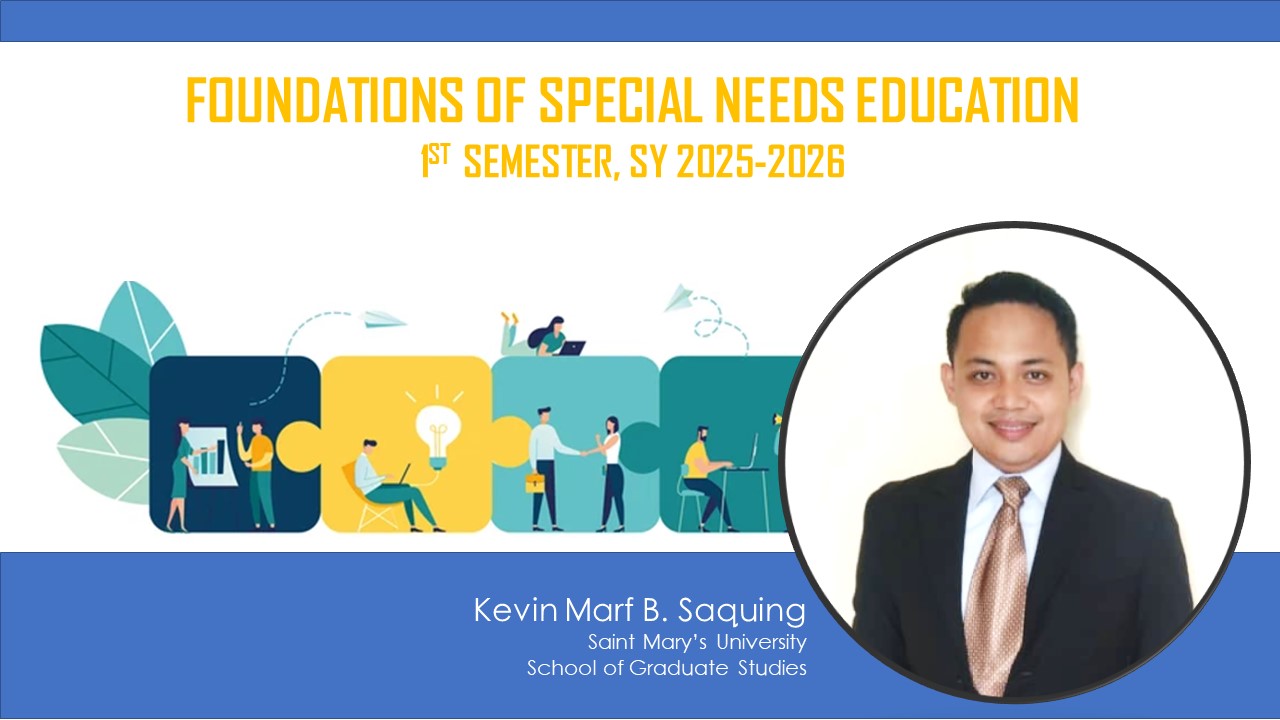
- Teacher: Kevin Marf Saquing
- Enrolled students: 28
- Enrolled students: No students enrolled in this course yet
- Teacher: Ronnie Dumale
- Enrolled students: 24
- Teacher: JOY AGRIMOR
- Enrolled students: 29
- Teacher: MELANIE GURAT
- Enrolled students: 10
This course is designed to provide students with the knowledge, skills, and practical experience necessary to become effective leaders and administrators in a specialized hospital and community setting. It is the final academic course of the MSN program, and it is intended to enhance learners' leadership and administration capabilities while improving their confidence in the exercise of being a future nurse administrator. Through this intensive practicum, students will apply theoretical knowledge in a practical setting, gain insight into the realities of healthcare administration, and develop a comprehensive understanding of the role of the nurse administrator.
- Teacher: JOMAN BALITON
- Enrolled students: 1

COURSE DESCRIPTION:
This course deals with the study of the basic concepts of management, planning, organizing, leading, staffing, controlling as applied to a Clinical laboratory set-up like quality assurance/ quality control; policy and procedure manuals; infection controls. Etc.
COURSE OBJECTIVES:
At the end of the course, the student will be able to:
1. Explain the different processes of management
2. Prepare and critique: Organizational chart, procedure and policy manual; general physical plan and layout; and job description
3. Manifest a desire to develop the Medical Technologist’s personal, social and professional responsibilities in helping, restoring or maintaining the health of man of high moral and ethical standards that are required of the Medical Technology Profession
- Enrolled students: 38
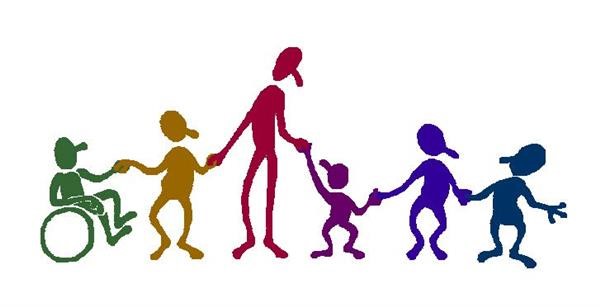
Definition, categories, identification, learning characteristics of learners with sensory and physical disabilities; curricular priorities, educational placement and strategies for teaching learners with sensory and physical disabilities.
- Teacher: Reyalyn ANTONIO
- Enrolled students: 1
- Teacher: Marie Joy Salgado
- Enrolled students: 41

- Teacher: Marie Joy Salgado
- Enrolled students: 64
- Teacher: MARYLIN PEROLINA
- Enrolled students: 7
- Teacher: SHERYLOU BENIG
- Enrolled students: 2
- Teacher: Caroline Acosta
- Enrolled students: 3
This course is the last of the series of courses in calculus. It serves in general to review and extend fundamental concepts already presented in elementary calculus. It gives a systematic, modern approach to differential and integral calculus of functions and transformations in several variables. It covers R as a complete ordered field, point set topology, limits and continuity, the derivatives, multivariable differential calculus, implicit functions and extrema problems, convergence of sequences and series of real numbers, sequences and series of functions, uniform convergence, power series, functions of bounded variation and rectifiable curves, Riemann-Stieltjes integrals; interchanging of limit operations, multiple integration, improper integrals and transformations.
- Teacher: DONNA BEE TOMINEZ
- Enrolled students: 13
This course is an application of mathematics to various fields. It introduces discrete and continuous models, model fitting and optimization. Applications involve real-world problems from business, engineering and life sciences. Lectures are supplemented by computer laboratory sessions.
- Teacher: MELANIE GURAT
- Enrolled students: 14
- Teacher: WENSON EVANGELISTA
- Enrolled students: 30
- Teacher: ANALYN GUEVARA
- Enrolled students: 8
- Teacher: MARY GRACE MEDINA BULATAO
- Enrolled students: 10

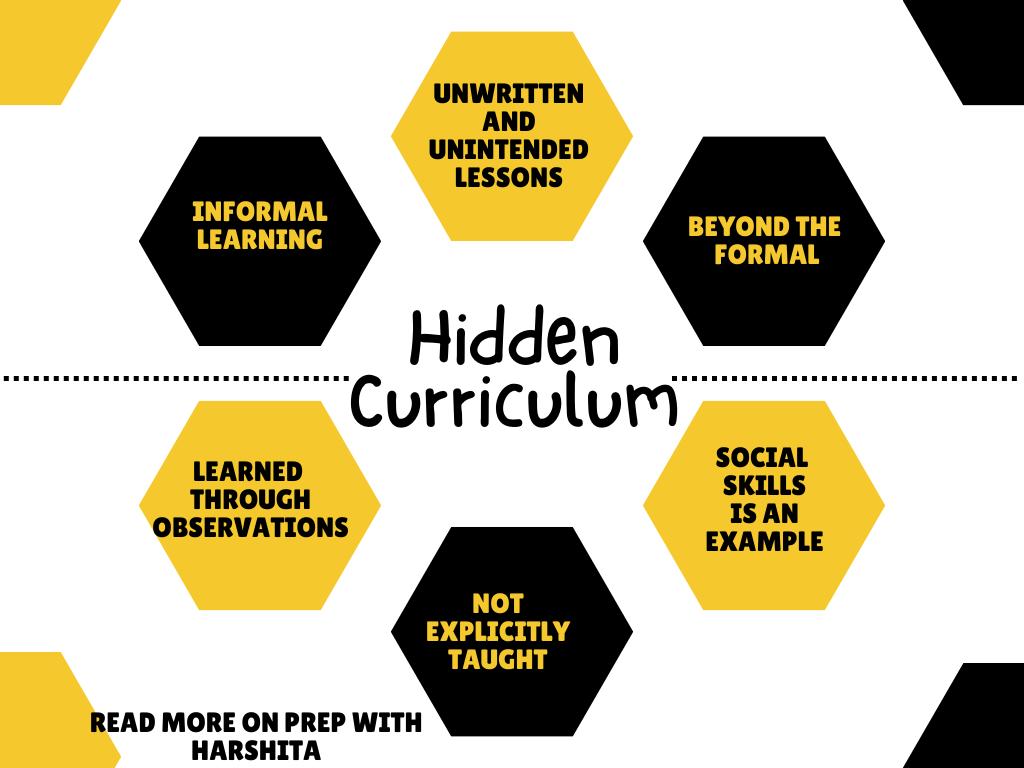
This course deals with the organization and management of Physical Education. It contains topics that widen the perspective of the students on the management of Physical Education. It is designed to provide a comprehensive, contemporary subject for administration and management courses in the fields of Physical Education and sports in the educational setting.
- Teacher: MARY GRACE MEDINA BULATAO
- Enrolled students: 2
- Teacher: JOMAN BALITON
- Enrolled students: 1
- Teacher: JOMAN BALITON
- Enrolled students: 1

Congratulations on enrolling in NCM 110 LAB. Before anything else, please read this guide carefully and completely. It is quite long, but this should not scare you: I have tried to provide as much detailed information as possible, in order to facilitate your understanding of the general and specific guidelines on how to deal with this course.
This deals with concepts, principles, theories & techniques on nursing informatics in clinical practice, education & research. The learners are expected to use the system of informatics to support the delivery of health care.
ONLINE TEACHER
I am Martin Gabriel T Manuel, a Registered Nurse, from Bambang, Nueva Vizcaya. I have completed my Bachelor of Sciences in Nursing in 2019 at Saint Mary’s University.
For contacts outside The “Learning Manage System” and for exams, only use the mention option at the class group chat (messenger). I will respond as soon as I can.
- Teacher: Martin Gabriel Manuel
- Enrolled students: 51
This course is a critical survey of various philosophical views of education, their similarities and differences, in the way leading philosophers and educators define the purpose of education, the role of the teacher and the function of the school, the nature of the curriculum and assessment, the nature of the learner and the method of instruction. It also includes a personal clarification of one’s purpose of schooling, his/her role as a teacher, what s/he should teach, and by what method. It attempts to show the invaluable position of philosophy in understanding and creating educational theories. And ultimately, it will survey specific application of these philosophic views among philosophers and educators throughout the history of education.
- Teacher: Felipe Nantes
- Enrolled students: 14

Practical English Spoken English Program (PSEP) is a general course offered to all freshmen students. It is designed to help students become more confident and fluent speakers in English for personal, group and even public communication. Through the oral speaking tasks and activities prepared, students will develop their confidence in speaking in front of an audience, improve their diction and enhance their oral presentation skills. They will also learn to talk about topics with substance and organization. Lastly, to address the current language needs of students, tasks in Conversational English are prepared
- Teacher: Susana Cadano
- Enrolled students: 28
- Teacher: Paul Morales
- Enrolled students: 43
- Teacher: ADONIS GARCES
- Enrolled students: 8
- Enrolled students: No students enrolled in this course yet
![Research and Statistics (ED 211[<span class="highlight">161</span>3] MAT - Bio)](https://lms.smu.edu.ph/pluginfile.php/197598/course/overviewfiles/1613.PNG)
- Teacher: MELANIE GURAT
- Enrolled students: 1
- Enrolled students: 3
- Teacher: CHRISTOPHER ALLEN MARQUEZ
- Enrolled students: 20
- Teacher: Arlene Tabaquero
- Enrolled students: 8
- Enrolled students: No students enrolled in this course yet

- Teacher: HARRISON VILLANUEVA
- Enrolled students: 33
- Teacher: REGINA RAMEL
- Enrolled students: 3
- Teacher: Arlene Tabaquero
- Enrolled students: 30
- Teacher: Arlene Tabaquero
- Enrolled students: 74
- Teacher: SHERYLOU BENIG
- Enrolled students: 5